Back to Holland
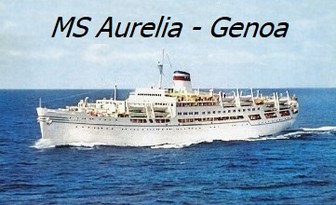
Cogedar Line - MS Auralia - Genoa
After four and a half years of living in Australia, my father decided it was time to return to his beloved Holland. He struggled to adjust to Australia and was deeply homesick for his family and the familiar comfort of Dutch pubs. His work required him to travel increasingly farther from home, and he only returned on weekends, which strained our family bond.
Dad faced significant challenges with the English language and never managed to learn it well. This difficulty was exacerbated by his decision to employ only Dutch people in his house-painting firm, which hindered his language acquisition. Despite his best efforts, the cultural and linguistic barriers proved too much.
Our house in St Marys was sold, and we rented temporary accommodation in Kingswood until it was time to board the MS Auralia for our voyage back to Holland. We spent a couple of nights at my Auntie Toos’s place before heading to Circular Quay. All our furniture had already been packed into a large crate.
This time, we were not migrants but paying passengers. Our parents booked passage through Cogedar Lines in Sydney, and we travelled on the MS Auralia through the Suez Canal back to Rotterdam. Built in 1939 as a freighter between Hamburg and Genoa, Cogedar Lines bought the ship in 1954 and refitted it as a passenger liner.
We boarded in August 1963 for a five-week journey, which would take us to Melbourne, Adelaide, Fremantle, Aden, Suez, Port Said, Naples, and Southampton before arriving in Rotterdam.


We slept in a four-berth cabin with our mother, while Dad shared another four-berth cabin with four other men.
The first thing we heard as we came on board was The Shadows’ rendition of their hit song “Telstar,” playing loudly on the jukebox located on the Lido Deck. Everyone on this trip will always remember that record. It was played repeatedly, and even my younger brother Dick, who was only nine at the time, still talks about it.
I was almost thirteen when we left and felt somewhat caught between age groups—too old to play with younger children and too young to hang out with teenagers. However, the fantastic crew made the trip adventurous and memorable.

Our first port of call was Melbourne, followed by Adelaide and Fremantle, before we sailed onto the Indian Ocean, bidding farewell to Australia. I only remember disembarking in Adelaide and Fremantle, where we took a train from the docks to visit the city.

The crossing of the Indian Ocean was a long journey. Each day grew warmer, and the ocean was so calm it could have been mistaken for a large lake. The ship carved its way through the water like a knife through butter. During this time, my parents befriended another Dutch couple, and my younger brothers often played with their children.
Life on board was much more luxurious than our voyage to Australia in 1959 on the MS Sibajak. However, many parents, including mine, complained about the freshness of the fruit given to the children. Half of it was spoiled and lacked vitamins. The captain promised to rectify this at the first available stop.
During the crossing of the equator, we had to prove to Neptune that we were worthy to enter his Kingdom. We were rewarded with certificates from Neptune, written in Italian.


The journey seemed endless before we reached Aden. I kept myself busy in the ship’s library, where I was lucky to find a few English adventure books. The swimming pool, although small, was a great place to cool off in the tropical heat, complete with a slide and various ball games.
After befriending some of the crew, I was allowed to enter the engine room—a sight to behold with its large machines and deafening noise. I also visited the bridge, where I marvelled at the array of buttons, knobs, and navigation equipment.


You could often find me in the cinema, which was converted into a small chapel every Sunday for mass. The Lido Deck and its bar were also among my favourite haunts.
In Aden, the harbour was too small for our ship, so we were ferried to shore in small boats. Yemen had recently gained independence from British rule, and the poverty was heartbreaking. The streets were filled with children begging for money, some with missing limbs. The British were often blamed, but we later learned it was the parents who inflicted these injuries to improve their children’s begging prospects.

From Aden, we sailed to Suez, where small boats approached us with souvenirs. Transactions were conducted through baskets and ropes, with haggling over prices. My parents purchased a small brass sphinx mounted on onyx, which adorned our mantelpiece for years.
Passengers before us were allowed to disembark in Suez to visit the pyramids, rejoining the ship in Port Said. However, due to the region's instability, this was discouraged. Some adventurous passengers still took the risk.
Our passage through the Suez Canal was less impressive than the Panama Canal. We saw sailing boats, camels, desert dunes, and continuously searched for pyramids, but found none.
We arrived in Port Said in the evening and were advised to stay on board. Our passengers from Suez returned safely, boasting of their adventures.

Sailing through the Mediterranean, we reached Naples, Italy, where we spent a whole day exploring the city. It was my brother Dick’s birthday, and Mum was on the lookout for an Italian accordion. Dad got frustrated with the high prices of ice cream, calling the vendors "rip-off merchants." We could see Mount Vesuvius in the distance.
As we sailed past Gibraltar into the Atlantic Ocean, the weather grew colder and windier. In the Gulf of Biscay, we encountered a massive hurricane. The ship was tossed wildly, with waves as high as houses. We were confined indoors for safety, and many passengers, including my family, suffered from seasickness.
In Southampton, many English passengers disembarked, and we were eager to reach Rotterdam. Finally, we arrived, greeted by our extended family waving from the docks. We had completed a circumnavigation of the globe.
After a few weeks, Dad expressed a desire to return to Australia, but Mum was adamant: “Only once around the world… never again!”
This story has been composed with great help from my brother Dick, who seemed to have enjoyed the trip more than I did.
Below some photos of the voyage and the ship,
Our arrival in Naples and a photo of myself standing at the bow of the ship.


Many thanks to ssmaritime for some of the history and pictures of the MS Aurelia.
For further information on the MS Aurelia please follow the link to http://ssmaritime.com/aurelia.htm
Thank you for joining me on my journey